
Kochi, June 1, 2026 – In 2006, months before a devastating Chikungunya outbreak overwhelmed hospitals across parts of Kerala, the warning signs were already there. Buried within a routine disease surveillance report was an unusual figure: more than 1,000 fever cases in a district that usually reported around 250. The data existed. The outbreak still happened.
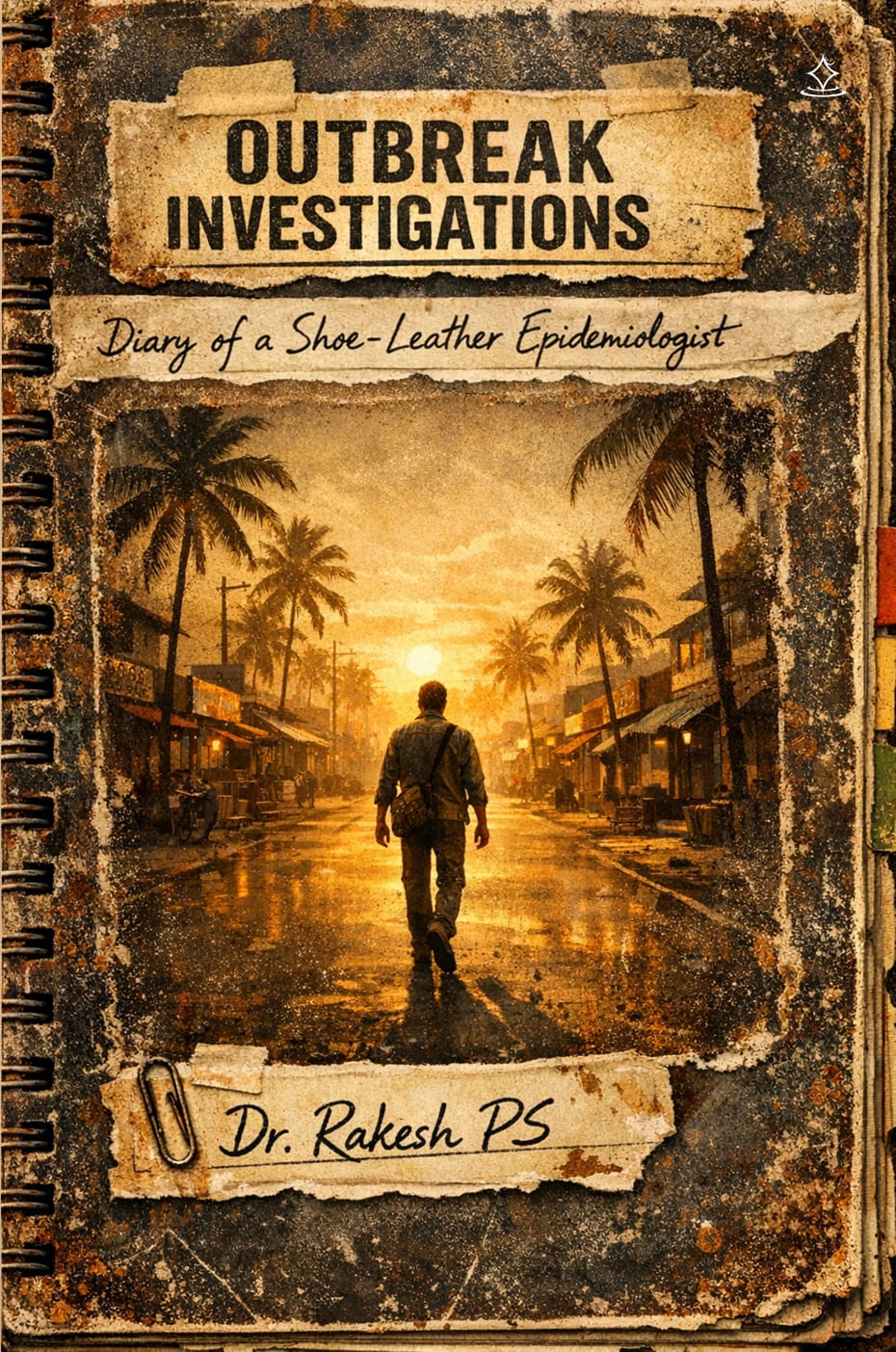
For public health physician and epidemiologist Dr. Rakesh PS, then a young medical intern witnessing the crisis firsthand, the experience became an enduring lesson about the limitations of health systems and the consequences of uncertainty. Years later, that lesson would become the opening story of Outbreak Investigations: Diary of a Shoe-Leather Epidemiologist, a new book that takes readers into the little-known world of outbreak investigation.
The title refers to “shoe-leather epidemiology”—the practice of solving outbreaks by walking streets, knocking on doors, interviewing families, tracing water pipelines and following clues on the ground. Based on more than 20 outbreak investigations conducted during the formative years of the author’s career, the book combines memoir, public health practice and detective-style storytelling to reveal how epidemiologists work behind the scenes to identify the source of disease and prevent further spread.
Through stories of contaminated water supplies, unexplained fevers, community panic and sleepless nights spent searching for answers, the book offers a rare insider account of a profession that often remains invisible to the public. At times, the narrative reads less like a public health textbook and more like a crime story, with clues emerging from hand-drawn maps, laboratory reports, surveillance data and unexpected observations in the field.
The author argues that many of the world’s most important public health lessons have emerged from low- and middle-income countries, yet the voices of field investigators working in these settings remain underrepresented in published literature. Drawing from investigations conducted in communities across India, the book explores challenges that resonate far beyond any single geography: surveillance failures, misinformation, political pressure, public fear, institutional inertia and ethical decision-making under uncertainty.
Dr. Rakesh PS, a public health physician trained at Christian Medical College, Vellore, a Bernard Lown Scholar at Harvard T.H. Chan School of Public Health, and former consultant with the World Health Organization (WHO) and The Union, says “Every outbreak begins with uncertainty. The challenge is making decisions before certainty arrives.”
The stories describe investigators making urgent decisions with incomplete information while communities demand answers and the outbreak continue to spread.
Beyond epidemiological methods, the book examines the human side of public health practice. Some of its most memorable chapters are not about pathogens at all, but about people. In one chapter, the author describes how some of the most important clues emerged not from official reports but from sitting on floor mats in village homes, talking to families, observing daily routines and understanding the realities of affected communities.
The book places considerable emphasis on ethics. During the COVID-19 pandemic, the author questioned practices such as publishing personally identifiable information of infected individuals, leading to disagreements with officials who viewed such disclosures as necessary for public safety. The episode becomes a broader reflection on a question faced by health systems worldwide: how much privacy should be sacrificed during a public health emergency? Through stories including that of a young boy caught in the public gaze during a health crisis, the author argues that scientific investigation must never come at the expense of human dignity.
The narrative further explores what the author describes as the psychology of outbreaks. Scientific evidence alone rarely determines the course of a response. Media narratives, political considerations, public anxiety and assumptions rooted in “common sense” can influence decisions in ways that investigators must constantly navigate.
Unlike many public health narratives that focus primarily on successful interventions, Outbreak Investigations spends considerable time examining uncertainty, mistakes, institutional limitations and the investigator’s own doubts. Readers looking for heroic tales of flawless decision-making may be surprised. The book is notable for its willingness to expose the ambiguities, frustrations and imperfect realities that define public health work in the real world.
At a time when outbreaks continue to shape societies across the globe, Outbreak Investigations offers a rare glimpse into the hidden work of the disease detectives who confront them—often far from public attention, and almost never according to the textbook.
Annexure
About the Author:
Dr. Rakesh PS (MD, PhD) is a public health physician, epidemiologist and author with more than 15 years of experience in tuberculosis elimination, disease surveillance and health-system strengthening. He has served with the World Health Organization (WHO) and The Union, and played a key technical role in the roadmap that led Lakshadweep to become the first geography in India to be declared TB-free. A graduate of Christian Medical College (CMC), Vellore, he holds a PhD in Public Health and is a Bernard Lown Scholar at the Harvard T.H. Chan School of Public Health.
LinkedIn: https://www.linkedin.com/in/rakeshpsuseela/
Book Specifications:
- Genre: Narrative Non-Fiction / Public Health / Epidemiology
- Title: Outbreak Investigations: Diary of a Shoe-Leather Epidemiologist
- Themes: Outbreak Investigation, Disease Surveillance, Public Health Ethics, Field Epidemiology, Health Systems
- Publisher: Shashwat Publication
- ISBN: 978-93-7462-535-4
- Format: Paperback (89 pages) / eBook
- Price: INR 200.00 (Paperback) / INR 99.00 (eBook
Media Contact:
For review copies, excerpt permissions, or interview requests with Dr. Rakesh PS, please contact:
- Email: rakeshrenjini@gmail.com
